
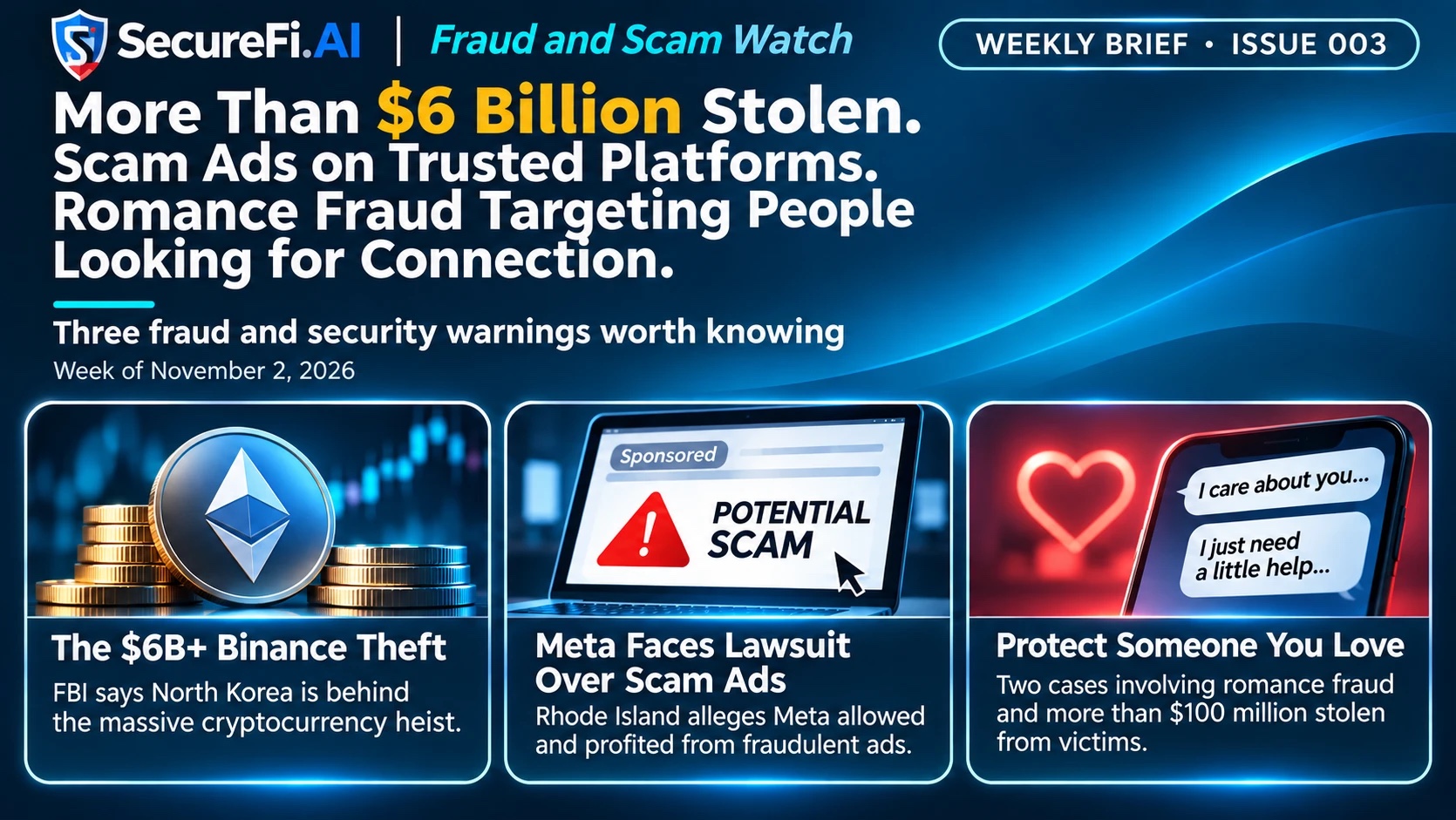
More than $6 billion stolen. Scam ads on trusted platforms. Romance fraud targeting people looking for connection.
Three fraud and security warnings worth knowing
In brief
- North Korea and the $6 billion Binance theft: The FBI attributed the theft of more than $6 billion in cryptocurrency to North Korean cyber actors. Binance says it is using company resources to replace stolen assets and protect customers from bearing the financial loss.
- Meta faces a lawsuit over scam advertising: Rhode Island alleges that Meta allowed and profited from fraudulent advertisements on its platforms. Meta disputes the allegations. The case highlights why an advertisement appearing on a familiar platform is not proof of legitimacy.
- Romance scams devastate lives and finances: Two recent Justice Department announcements describe criminal conspiracies involving more than $100 million and $9 million in victim losses. The cases illustrate how criminals exploit personal relationships, particularly among older adults.
These stories look different, but they share something important.
Criminals exploit trust in financial institutions, familiar technology platforms, and personal relationships.
This week, SecureFi highlights three official warnings and practical steps you can take to protect yourself and the people you care about.
This week's warnings
More than $6 billion stolen: North Korea linked to cryptocurrency attack
On October 31, 2026, the Federal Bureau of Investigation attributed the theft of more than $6 billion in virtual assets from cryptocurrency exchange Binance to North Korean cyber actors.
The attack occurred around October 29 and is associated with a North Korean cyber operation known as TraderTraitor.
According to the FBI, investigators observed the actors converting stolen assets primarily into Ethereum, with additional laundering expected through decentralized financial services and cryptocurrency exchanges.
Binance reported approximately $6.3 billion in stolen assets.
Were customers affected?
The stolen assets came from Binance's cryptocurrency infrastructure. Binance says it will absorb the financial impact rather than pass the loss to customers.
As of October 31, Binance reported that it had replenished approximately 90% of affected assets using company resources, with efforts continuing to replace the remainder.
Replenishing assets is not the same as recovering stolen funds from the criminals.
Why this matters
The scale of the theft demonstrates how much financial value can be exposed when digital systems are compromised.
Most consumers will never operate a cryptocurrency exchange, but the incident highlights risks that affect ordinary people:
- Criminals may impersonate legitimate exchanges after major incidents.
- Fake recovery services may promise to retrieve stolen cryptocurrency.
- Fraudulent security notices may attempt to steal passwords or wallet credentials.
- Criminals may use public concern about an incident to create urgency.
What to do
If you use cryptocurrency:
- Enable strong multifactor authentication wherever available.
- Never share private keys or wallet recovery phrases.
- Verify security notices through your exchange's official website or app.
- Be skeptical of anyone promising guaranteed recovery of stolen assets.
- Review account activity and report unauthorized transactions promptly.
If you do not use cryptocurrency, the same lesson applies to your financial accounts: an unexpected security message should always be independently verified.
If you suspect cryptocurrency fraud
Contact your financial institution or cryptocurrency provider immediately, preserve transaction records, and file a report at FBI IC3.
A major security incident can create opportunities for additional scams.
A message claiming to protect or recover your money may itself be the threat. Verify the source before responding.
Meta faces lawsuit over fraudulent advertising: A familiar platform does not guarantee a safe advertisement
On October 22, 2026, Rhode Island Attorney General Peter Neronha filed a lawsuit against Meta, the parent company of Facebook and Instagram.
The lawsuit alleges that Meta failed to adequately prevent fraudulent advertising despite publicly representing that it had sophisticated measures to combat scams.
The state alleges that Meta's advertising systems helped distribute and target deceptive advertisements involving:
- Fake investment opportunities
- Impersonation of trusted organizations and public figures
- Misleading Medicare and Social Security offers
- Fraudulent products and services
- Other deceptive financial schemes
The lawsuit seeks monetary penalties, restitution, and changes to Meta's practices.
These are allegations, not established findings of liability. Meta disputes the lawsuit. A company spokesperson said Meta has removed more than 159 million scam ads and that the suit ignores the actions it takes to combat scams.
Why this matters
Consumers may assume an advertisement is trustworthy because it appears on Facebook, Instagram, or another familiar service.
But paid placement is not independent verification.
Criminals may use professional photographs, familiar logos, AI-generated celebrity endorsements, and convincing websites to make fraudulent offers appear legitimate.
An advertisement can look exactly like something you would expect from a real business.
What to do
Before responding to an online advertisement:
- Be skeptical of guaranteed investment returns or extraordinary discounts.
- Check the advertiser's website and identity independently.
- Do not rely solely on reviews or testimonials appearing within the advertisement.
- Watch for fake endorsements or AI-generated videos of recognizable individuals.
- Avoid providing personal information until you have verified the organization.
- Be especially cautious if someone wants to move the conversation into a private messaging application.
If you encounter a suspected scam advertisement
Report it to the platform. Financial fraud can also be reported at ReportFraud.ftc.gov.
If you already sent money, contact your bank or payment provider immediately.
A familiar platform does not make every advertisement on that platform trustworthy.
Advertising may introduce an offer. Verification should determine whether you act on it.
Protect Someone You Love: Romance scammers exploit emotional trust
Two recent Justice Department announcements show the financial and emotional damage caused by organized romance fraud.
On October 29, federal prosecutors in New York announced that two men associated with a Ghana-based criminal organization had pleaded guilty to conspiracy to commit wire fraud.
According to the Justice Department, the organization stole and laundered more than $100 million through romance scams and business email compromise schemes.
Many victims were older adults who believed they had formed genuine romantic relationships online.
In a separate case announced October 26, federal prosecutors in Ohio reported that three defendants had pleaded guilty for their roles in an international romance fraud conspiracy.
Victims, mostly older Americans, lost more than $9 million collectively.
Why this matters
Romance scams are not always quick requests for money.
Criminals may spend weeks or months developing an emotional connection.
They may communicate daily, express affection, discuss future plans, and gradually build a relationship that feels genuine.
Only after establishing trust do they introduce a financial emergency, investment opportunity, travel problem, or request for help.
For the person being targeted, the relationship may feel completely real.
That is what makes these scams so damaging.
Warning signs
Be cautious when an online relationship involves:
- Repeated excuses for being unable to meet in person
- Unexpected emergencies requiring money
- Requests involving cryptocurrency, gift cards, or wire transfers
- Pressure to keep the relationship secret
- Claims that financial assistance will finally allow the person to visit
- Requests to receive, transfer, or forward money for someone else
How to help someone you love
If you believe a family member or friend may be involved in a romance scam, how you approach them matters.
Avoid embarrassment, confrontation, or criticism.
Instead:
- Listen without judgment.
- Ask questions about the relationship and any financial requests.
- Encourage independent identity verification.
- Offer to review messages or unusual requests together.
- Suggest slowing or stopping financial transfers while concerns are reviewed.
- Remind them that asking for help is a sign of strength.
Someone may recognize warning signs yet struggle to disengage emotionally.
Patience, dignity, and continued connection are important.
If money has already been sent
Contact the bank or payment provider immediately. Preserve messages, account details, and transaction records.
Report suspected fraud to FBI IC3 or FTC ReportFraud.
Romance fraud exploits human connection, not simply a lack of cybersecurity knowledge.
Protecting someone may begin with a conversation rather than a warning.
Election Day, November 3
With Election Day approaching, watch for unexpected texts, emails, and social media messages claiming last-minute changes to voting locations, eligibility, or procedures.
Verify voting information directly with your state or local election office.
For official election information, visit USA.gov Voting and Elections.
For additional background, see SecureFi's Election Edition Intelligence Brief.
The SecureFi takeaway: Trust deserves verification
This week's warnings involve three very different forms of trust:
- Trust in the technology protecting our financial assets
- Trust in advertisements appearing on established online platforms
- Trust in people who create meaningful personal relationships
The protective habit is the same.
- Pause. Do not let fear, excitement, urgency, or emotional pressure force a decision.
- Verify independently. Use information and contact details you obtained yourself.
- Recognize the warning signs. A convincing message, professional presentation, or familiar identity is not proof of legitimacy.
- Act quickly if harmed. Contact the appropriate institution, preserve evidence, and use trusted reporting and recovery resources.
SecureFi.AI is designed to help individuals and families understand risks, evaluate suspicious situations before acting, and find practical next steps when something has already gone wrong.
Edited by David Haberland · Published by SecureFi, Inc. · All Fraud and Scam Watch editions · New edition every week · Follow on LinkedIn · RSS