

A Call to Protect Your Savings. Gift Cards Tampered With Before Sale. A Price That Changes at Checkout.
Three consumer fraud and financial-protection warnings worth knowing
In brief
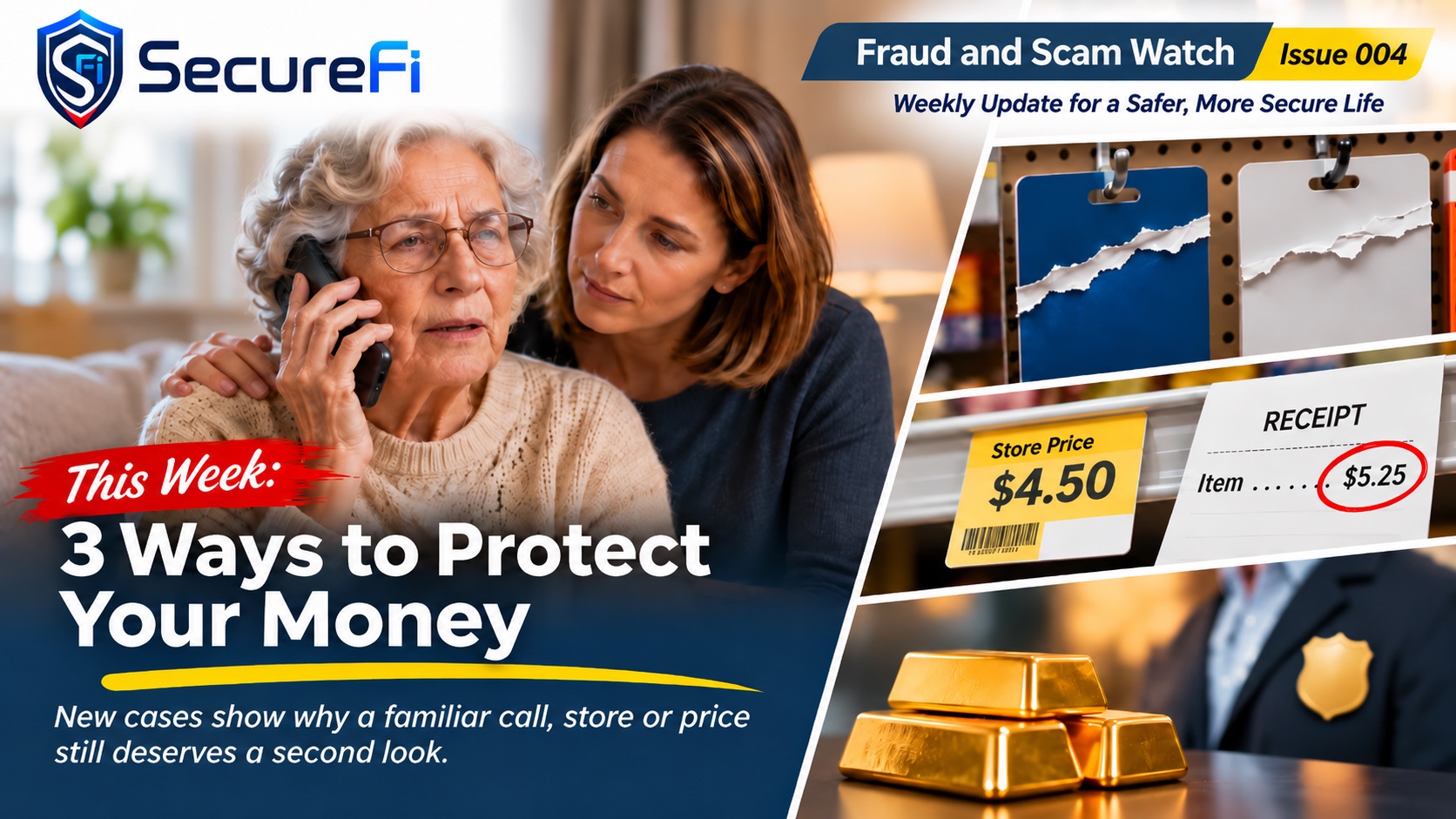
- Protect Someone You Love: Someone claiming to be a government official asks you to move your money. An unexpected caller claims your savings are in danger and tells you to withdraw cash or buy gold for safekeeping. Recent federal cases show how criminals use this approach to exploit trust, particularly among older adults.What you can do: Never hand over money or valuables because of an unexpected call. Contact the agency independently.
- Gift Cards: Compromised before anyone buys them. A November 4 federal guilty plea revealed how someone altered gift cards and returned them to retail displays. Authorities recovered 134 compromised cards before customers purchased them.What you can do: Inspect gift cards for tampering, keep your receipt, and verify the balance promptly.
- Checkout Prices: What happens when the amount charged doesn't match? The FTC and 20 states sued Dollar General on October 26, alleging repeated discrepancies between advertised prices and checkout charges. Dollar General disputes the allegations.What you can do: Compare shelf prices with the amount charged and ask for corrections when they differ.
Why These Stories Matter
Would you recognize a warning sign if it appeared during an ordinary day?
Someone claiming to be a government official calls to protect your savings. A gift card looks perfectly normal on a store rack. A checkout receipt shows a higher price than the shelf.
Each situation seems familiar. Yet recent federal investigations and consumer-protection actions demonstrate why a second look can matter.
This week, we examine what happened, what to watch for, and practical steps you can take to protect yourself and the people you care about.
This week's warnings
Protect Someone You Love: When Scammers Pretend to Protect Your Money
Imagine receiving this phone call
Someone claiming to represent a government agency tells you your bank account has been compromised.
They sound professional. They may know personal details about you. They insist your money is at risk and offer to help protect it.
But there's a catch.
They instruct you to withdraw cash, purchase gold bars, or arrange for someone to collect your valuables for safekeeping.
That request is the warning sign.
Government agencies do not require people to surrender cash or gold to strangers to protect their savings.
What happened
On November 4, the Federal Trade Commission published consumer guidance highlighting its latest report on fraud affecting older adults.
According to the FTC, reported fraud losses among Americans age 60 and older increased from approximately $600 million in 2020 to $3 billion in 2025.
These are reported annual losses, not a measure of fraud occurring during the past week, and they do not represent every incident.
The FTC highlighted particular concerns involving government impersonation, technology support, and prize scams.
A federal case announced November 5 illustrates how devastating this deception can become.
The Justice Department reported that Prakashkumar Prajapati was sentenced to nine years in prison for participating in a fraud scheme involving at least eight victims across five states.
Criminals posing as government officials persuaded victims to withdraw money or purchase gold, supposedly to protect their assets.
They then arranged for individuals posing as government representatives to collect the money or gold.
In one Maine incident, a victim was instructed by someone posing as a Federal Trade Commission employee to hand over gold bars to a person sent to collect them.
Prajapati was ordered to pay approximately $1.9 million in restitution.
Also on November 5, federal prosecutors in Florida announced a separate indictment against ten individuals allegedly involved in another gold-bar fraud scheme targeting older adults. Those charges remain allegations, and the defendants are presumed innocent unless proven guilty.
Why this matters to you
These scams do not depend on someone being careless or unfamiliar with technology.
They depend on creating fear, urgency, and the belief that a trusted authority is offering protection.
For an older adult who believes their life savings are in danger, the caller's instructions may sound like the safest option.
And the emotional consequences can be as significant as the financial loss.
A person may feel frightened, embarrassed, or uncertain about whom to trust.
That's why protecting someone often begins with a respectful conversation rather than a warning or confrontation.
Warning signs
Be cautious if someone claiming to represent a government agency:
- Says your money must be moved immediately to keep it safe.
- Instructs you to purchase gold, cryptocurrency, or gift cards.
- Arranges for someone to collect cash or valuables.
- Tells you to keep the conversation secret.
- Threatens arrest or other consequences if you do not cooperate.
How to help someone you love
If a parent, grandparent, neighbor, or friend receives an unusual financial request:
- Listen without judgment. Fear or embarrassment may make them reluctant to talk.
- Encourage a pause. Ask them not to withdraw money, purchase gold, or hand anything over until the request is independently verified.
- Help check the source. Contact the agency through its official website or a verified telephone number, never the number supplied by the caller.
- Offer to review the situation together. Avoid criticism or suggesting that the person should have known better.
- Stay involved. Scammers may call repeatedly and attempt to isolate someone from people they trust.
Protecting a loved one does not mean taking away their independence. It means helping them make an informed decision without pressure.
If money or valuables have already been surrendered
Contact the financial institution immediately and preserve messages, account information, transaction records, and relevant details.
Report suspected fraud to:
- FBI Internet Crime Complaint Center
- FTC ReportFraud
- National Elder Fraud Hotline: 1-833-372-8311 (833-FRAUD-11)
Someone claiming to protect your savings may be the person trying to steal them.
An unexpected caller should never determine where your money goes. Verify the request independently, and involve someone you trust before taking action.
What you can do nowOn a call like this right now? Three steps, and how to set up a family word.
Verify a caller →The Gift Card Scam That Starts Before You Buy
What if a gift card was already compromised before you purchased it?
That's the risk illustrated by a November 4 federal guilty plea.
Investigators recovered 134 compromised gift cards from a scheme to take cards from retail displays, alter them, and return them to stores.
Fortunately, all 134 cards were recovered before customers purchased them.
What happened
The Justice Department announced that Liang Xiong pleaded guilty in federal court in St. Louis to participating in a nationwide gift-card fraud scheme.
According to the plea agreement, Xiong removed cards from retail displays, exposed and recorded concealed identifying numbers, and returned the compromised cards to the racks.
The intended scheme was to use the recorded information after customers purchased and activated the cards.
Authorities recovered cards associated with three retailers. The Justice Department estimated that the cards could have carried approximately $58,300 in value if purchased and activated.
No customer losses were reported from these 134 recovered cards. The potential value is not an amount that was stolen from customers.
Xiong's sentencing is scheduled for February 10, 2027.
Why this matters to you
Gift cards are popular presents, particularly during the holidays.
We often assume that a card purchased from a legitimate retailer must be safe.
But the store can be legitimate, the transaction can be legitimate, and the card may still have been altered before purchase.
The problem might not become apparent until someone attempts to use the card.
What to watch for
Before purchasing a physical gift card, look for:
- Scratched, lifted, damaged, or replaced security coverings.
- Packaging that appears opened, resealed, or altered.
- Barcodes or identifying numbers that appear covered or modified.
- Cards that look noticeably different from others on the display.
Some tampering is difficult to detect, so an undamaged appearance does not guarantee that a card is safe.
What you can do
Before purchasing:
- Inspect the packaging and security features.
- When practical, choose cards stored behind a counter or in protected displays.
- Ask store staff about anything that appears unusual.
- Keep your receipt and activation confirmation.
After purchasing:
- Check the balance through the card issuer's verified website or telephone number.
- Encourage the recipient to verify the balance promptly.
- Contact the retailer and card issuer immediately if the balance is missing or incorrect.
Be careful when searching online for gift-card balance-checking websites. Fraudulent sites may attempt to steal the card's information.
Use the issuer's independently verified contact details.
If a gift-card balance has disappeared
Preserve the card, packaging, and receipt.
Contact the retailer and issuer promptly to ask about available remedies, and report suspected fraud at ReportFraud.ftc.gov.
A gift card can be compromised before it reaches the person receiving it.
A familiar store does not guarantee that every card is safe. Inspect the packaging, keep the receipt, and verify the balance.
What you can do nowGift cards show up in many scams. Would you spot them? Play a round of Trust or Don't Trust.
Test your judgment →When the Shelf Price Isn't the Checkout Price
Have you ever checked your receipt and discovered you paid more than expected?
Imagine seeing a household product advertised for $4.50 and then being charged $5.25 at checkout.
That's a hypothetical example, not a specific transaction documented in the lawsuit discussed below.
A difference of 75 cents may seem small. But when pricing discrepancies occur repeatedly, they can add up.
What happened
On October 26, the FTC and 20 states filed a lawsuit against Dollar General Corporation.
The lawsuit alleges repeated discrepancies between advertised prices and the amounts customers were charged at checkout.
According to the FTC, consumers allegedly paid more than the prices displayed on shelves, price tags, or advertisements.
The FTC and states allege that the company failed to adequately address the problem despite substantial consumer complaints.
The FTC describes the alleged cumulative consumer harm as amounting to millions of dollars.
These are allegations in a pending civil lawsuit, not established findings of liability.
Dollar General disputes the allegations.
The company says it strives for accurate pricing, has improved its price-accuracy processes, expects store employees to correct discrepancies, and intends to defend the litigation.
Why this matters to you
Not every consumer financial risk involves someone stealing a password, impersonating a government official, or attempting a criminal scam.
Sometimes the question is simpler:
Is the price we're charged the price we were shown?
Even small differences can matter, particularly for households watching everyday expenses.
What to watch for
- A checkout price higher than the shelf price.
- An advertised promotion that does not appear on the receipt.
- A discount that was not applied.
- Repeated pricing discrepancies at the same store.
A price mismatch does not automatically establish intentional deception. Mistakes can occur, but customers still deserve accurate pricing and appropriate corrections.
What you can do
While shopping:
- Pay attention to displayed prices.
- Check the register total when practical.
- Confirm that advertised discounts are applied.
After checkout:
- Review your receipt.
- Ask the store to correct discrepancies.
- Save the receipt and, when helpful, photograph the displayed price.
- Report recurring or unresolved concerns to your state or local consumer-protection agency.
Suspected deceptive business practices can also be reported through ReportFraud.ftc.gov.
Small amounts matter, especially when they add up.
Pay attention to displayed prices, review what you're charged, and ask for corrections when the amounts do not match.
Protecting your money includes everyday purchases, not just major financial decisions.
Your “bank's fraud department” calls. Your account is compromised, so move your money to a safe account they'll set up.
Holiday shopping and gift giving
As the holiday shopping season approaches, gift cards, online promotions, deliveries, and unexpected payment requests deserve additional attention.
If someone unexpectedly asks you to pay using gift cards, cryptocurrency, or a wire transfer, independently verify the request before proceeding.
Gift cards are for giving gifts. They are not a normal way to pay government agencies, resolve legal matters, or safeguard money during an investigation.
The SecureFi Takeaway: Trust Deserves Verification
This week's three stories involve different everyday situations.
- A phone call from someone who claims to protect your savings.
- A gift card that appears ready to purchase.
- A checkout price that should match what you were promised.
The common lesson is simple: something familiar isn't necessarily something we've verified. There are four habits worth remembering:
- Pause when something seems unusual. Fear, pressure, urgency, and confusion can interfere with careful decisions.
- Verify independently. Use contact information and sources you find yourself, rather than relying on what someone supplies.
- Keep useful records. Receipts, messages, photographs, and transaction details can help resolve problems and support fraud reports.
- Ask for help without embarrassment. Anyone can encounter a convincing scam or misleading situation. Protecting someone often begins with listening, not criticizing.
Our goal at SecureFi is not simply to tell people that threats exist. It is to help people understand what those threats mean, recognize warning signs, and make safer decisions.
Fraud and Scam Watch, in your inbox each week.
Three warnings from official sources, and what to do. We’re starting the weekly email soon: confirm your address and you’ll get the first one. No account needed.
Separate from product alerts. One-click unsubscribe in every email. See our Privacy Policy.
Edited by David Haberland · Published by SecureFi, Inc. · All Fraud and Scam Watch editions · New edition every week · Follow on LinkedIn · RSS