
The $6 Billion Breach: When Trusted Access Becomes the Attack Path
What the Binance cyberattack reveals about compromised access, digital financial systems, state-sponsored cybercrime, and the security of our everyday digital lives.
Executive Summary
On October 29, 2026, cryptocurrency exchange Binance suffered a cyberattack involving approximately $6.3 billion in digital assets. Two days later, the FBI attributed the theft to North Korean cyber actors operating under the name TraderTraitor.
The scale is extraordinary. But the most important lesson may not be the amount stolen.
Binance's initial investigation suggested that a compromised employee laptop may have allowed an attacker to reach an internal software service and initiate unauthorized withdrawals. Subsequent investigation identified additional points of compromise. The full sequence remains under investigation.
This raises a critical question for organizations and individuals alike:
What happens when an attacker gains access to something a system already trusts?
The answer reaches far beyond cryptocurrency. It applies to business networks, employee devices, email accounts, family computers, banking systems, and connected services.
The Binance incident provides an important opportunity to examine this broader risk, while recognizing that the technical investigation is not yet complete.
1. What Happened, and What We Still Don't Know
On October 31, the FBI attributed the theft of more than $6 billion from Binance to North Korea's TraderTraitor operation.
Binance estimated the impact at approximately $6.3 billion.
In its October 30 statements, Binance described a possible compromise involving a DevOps engineer's laptop.
A DevOps engineer helps develop, operate, automate, and maintain software infrastructure. Such work can involve access to systems and services that other employees do not use.
Binance initially reported that the compromised laptop may have enabled access to a service container, an isolated environment used to run an application or software component, from which unauthorized withdrawal transactions were submitted.
Binance later reported additional points of compromise.
The company also stated that it had found no evidence that wallet private keys had leaked. A private key is a secret cryptographic credential used to authorize certain digital-asset transactions.
That statement does not establish that the entire transaction-authorization system was secure. It means Binance had not identified evidence of leaked wallet private keys at the time of its announcement.
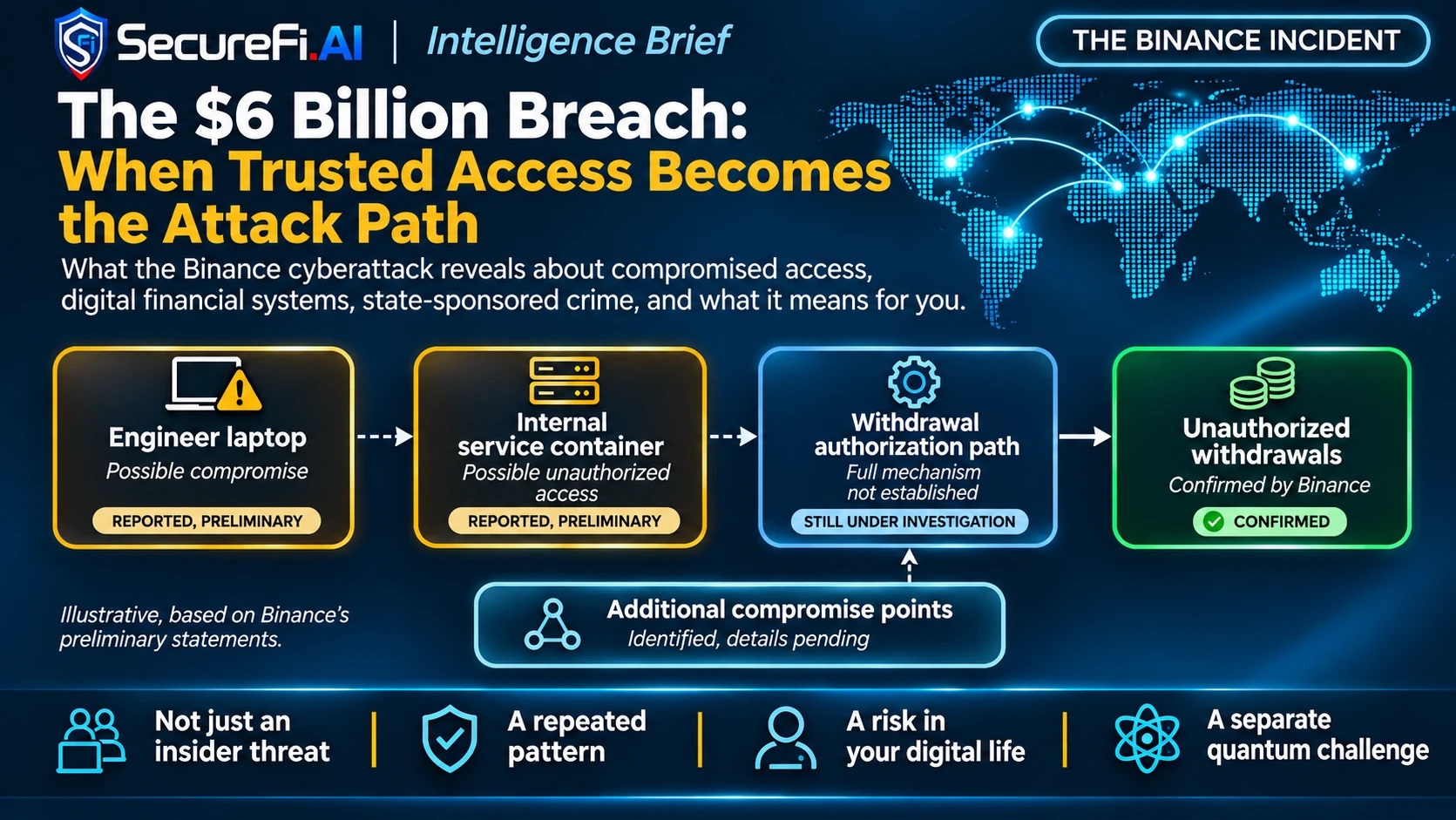
The possible attack path
- Engineer laptopPossible compromiseReported, preliminaryInitial Binance account
- Internal service containerPossible unauthorized accessReported, preliminaryReported possible pathAdditional compromise pointsIdentified, details pendingDetails pendingRelationship unknown
- Withdrawal authorization pathFull mechanism not establishedStill under investigation
- Unauthorized withdrawalsConfirmed by BinanceConfirmed
Binance reported suspending withdrawals, revoking affected authorizations, working to freeze stolen assets, and coordinating with law enforcement and blockchain intelligence firms.
The company said it would absorb the losses using its Secure Asset Fund for Users and corporate resources rather than pass the financial impact to customers.
As of its October 30 updates, Binance reported approximately $3 billion in stolen assets frozen on-chain. Frozen assets are not necessarily recovered assets.
The company has committed to publishing a detailed technical review once its investigation is complete.
Sources: FBI Cyber, October 31, 2026; Binance Security Incident Updates, October 30, 2026.
2. The Insider Risk: When Authorized Access Is Compromised
The word insider often suggests an employee intentionally stealing information or helping criminals.
That is only one form of insider-related security risk.
An employee can act maliciously. An employee can make an unintended mistake. Or an external criminal can compromise an employee's computer or credentials and use access that the organization would ordinarily trust.
These situations are fundamentally different.
There is currently no established evidence that a Binance employee intentionally participated in the theft.
The more important lesson is that an external attacker may be able to operate through compromised trusted access.
Consider a hypothetical situation.
An organization carefully protects its financial database. Only authorized employees and internal services can reach it.
But an attacker compromises a laptop belonging to someone who maintains the application. That laptop has access to tools, sessions, or services that interact with the database.
The attacker may not need to break the database's encryption. Instead, the attacker looks for an existing authorized path.
The same principle can apply to payment systems, cloud infrastructure, customer records, and cryptocurrency services.
The Zero Trust lesson
Zero Trust is a cybersecurity approach that avoids treating an identity, device, or connection as trustworthy merely because it belongs to an organization or has previously been authenticated.
It emphasizes verifying access, limiting permissions, monitoring activity, and protecting important operations even when another part of a system is compromised.
The Cybersecurity and Infrastructure Security Agency's Zero Trust Maturity Model provides a useful framework for these principles.
3. The Pattern: This Was Not the First TraderTraitor Theft
The Binance attack is especially significant when placed in historical context.
On February 26, 2025, the FBI attributed the theft of approximately $1.5 billion from cryptocurrency exchange Bybit to North Korean TraderTraitor actors.
In that case, the FBI warned that stolen assets were being converted and distributed across multiple blockchain networks and thousands of addresses.
Less than two years later, the FBI attributed another, much larger theft to the same named North Korean operation.
| Incident | FBI-reported theft | Attribution |
|---|---|---|
| Bybit, February 2025 | Approximately $1.5 billion | North Korea, TraderTraitor |
| Binance, October 2026 | More than $6 billion | North Korea, TraderTraitor |
The combined reported value exceeds $7.5 billion across these two incidents.
These attributions do not establish that the attackers used identical intrusion methods. They do demonstrate the scale and repeated nature of the financial threat.
Why tracing stolen cryptocurrency is difficult
Blockchain transactions can create visible records, but identifying and recovering stolen assets is not straightforward.
Criminals can move assets across different wallets, cryptocurrencies, exchanges, and decentralized financial services.
The FBI has called upon financial and blockchain infrastructure participants to help identify and block transactions associated with the stolen funds.
Recovery can require cooperation among law enforcement, cryptocurrency exchanges, asset issuers, blockchain analysts, and organizations operating across multiple countries.
4. What This Means for Your Digital Life
The Binance incident may seem distant from everyday life. Most people do not manage cryptocurrency infrastructure or operate financial trading platforms.
But the principle of compromised trusted access applies directly to ordinary households.
Your email account can become the attack path. An attacker who gains control of your primary email may be able to request password resets for banking, shopping, social media, and other accounts.
Your phone number can become the attack path. Through a fraudulent transfer of your mobile number, commonly called a SIM swap, criminals may intercept text-message security codes or account-recovery messages.
A shared family device can become the attack path. An infected computer may expose saved passwords, active sessions, personal files, or accounts used by other household members.
An authorized application can become the attack path. A connected application may retain permissions to access information or services long after those permissions are needed.
Five practical protections
- Use phishing-resistant authentication, such as passkeys or security keys, for your most important accounts when available.
- Protect your primary email account particularly carefully, and review recovery methods.
- Ask your mobile carrier about account-transfer and SIM-swap protections.
- Keep computers, phones, browsers, and applications updated.
- Review connected apps, shared accounts, and permissions you no longer need.
These steps cannot eliminate every threat, but they reduce opportunities for one compromised account or device to create a much larger problem.
5. The Quantum Question: A Different Challenge for the Future
The Binance theft also provides an opportunity to distinguish today's security failures from tomorrow's cryptographic risks.
There is no evidence that quantum computing caused or enabled this attack.
Today's threats include compromised identities, privileged access, vulnerable software, fraudulent authorization, and failures in monitoring or transaction controls.
Quantum computing presents a different challenge.
Some cryptographic algorithms used in digital signatures and other security functions could become vulnerable to sufficiently powerful future quantum computers.
That is important for cryptocurrency systems because many blockchain networks rely on classical digital signatures to authorize transactions.
On October 27, 2026, the National Institute of Standards and Technology announced its report Transition to Post-Quantum Cryptography Standards, NISTIR 8547.
The report provides guidance for moving away from cryptographic algorithms vulnerable to future quantum attacks.
For cryptocurrency ecosystems, making that transition can involve wallet software, transaction-signing methods, network protocols, governance, and coordination across many independent participants.
Quantum-resistant cryptography will not, by itself, prevent an attacker from compromising an employee's laptop or abusing legitimate access.
6. Three Questions Every Organization Should Ask
The Binance incident offers lessons for financial institutions, businesses, government agencies, and technology providers.
1. If a trusted employee device or account is compromised, how far can an attacker go?
Organizations should examine access permissions, connected services, privileged accounts, developer environments, and the ability to move between systems.
2. What independent controls protect high-impact actions?
A successful login should not automatically authorize every financial transaction or sensitive operation.
Transaction limits, separation of duties, additional approvals, monitoring, and the ability to revoke access can help reduce the impact of a compromise.
3. What happens when prevention fails?
Organizations need rehearsed procedures for containment, customer protection, evidence preservation, recovery, and coordination with affected parties.
The objective is not to assume that every breach can be prevented.
It is to reduce the likelihood that one compromised system can produce catastrophic consequences.
SecureFi Assessment: Trust Must Be Continuously Verified
The lessons from Binance extend well beyond cryptocurrency.
The incident illustrates why security cannot depend entirely on protecting a single account, device, credential, or system.
Attackers search for relationships between systems. They look for access that is already permitted, functions that are already trusted, and processes that can be manipulated.
The same pattern can affect an individual whose email account controls password recovery, a family whose shared devices connect multiple accounts, or an enterprise whose internal services can perform high-value transactions.
The response requires more than stronger passwords or encryption.
It requires understanding how access is granted, what actions that access permits, how unusual activity is detected, and what happens when a trusted component becomes compromised.
The future adds another responsibility: ensuring that the cryptographic systems used to establish digital trust can adapt as technology advances.
The central lesson is straightforward:
Do not assume that access is safe simply because it comes through something previously trusted.
Verify the identity. Verify the authority. Verify the action.
And prepare for the possibility that one trusted component may fail.
Check before you act.
Sources and References
- Federal Bureau of InvestigationNorth Korea Responsible for $6 Billion+ Binance Attack. October 31, 2026.
- BinanceSecurity Incident Update. October 30, 2026.
- BinanceSecurity Incident Update #2. October 30, 2026.
- Federal Bureau of InvestigationNorth Korea Responsible for $1.5 Billion Bybit Hack. February 26, 2025.
- National Institute of Standards and Technology
- Cybersecurity and Infrastructure Security Agency