
Cybersecurity Awareness Month: What the Threats and National Cyber Defenders Revealed
From exploited vulnerabilities and state-sponsored cyber activity to trusted access, critical infrastructure, and organizational resilience.
Executive Summary
October was Cybersecurity Awareness Month, with federal and state organizations emphasizing stronger authentication, Zero Trust, critical-infrastructure protection, and cyber resilience.
The month's reported threats demonstrated why those priorities matter.
The FBI attributed a theft exceeding $6 billion in cryptocurrency to North Korean cyber actors. Federal agencies warned about ransomware, compromised remote-access systems, and China-linked cyber operations. The Justice Department announced enforcement actions addressing North Korean remote IT worker schemes.
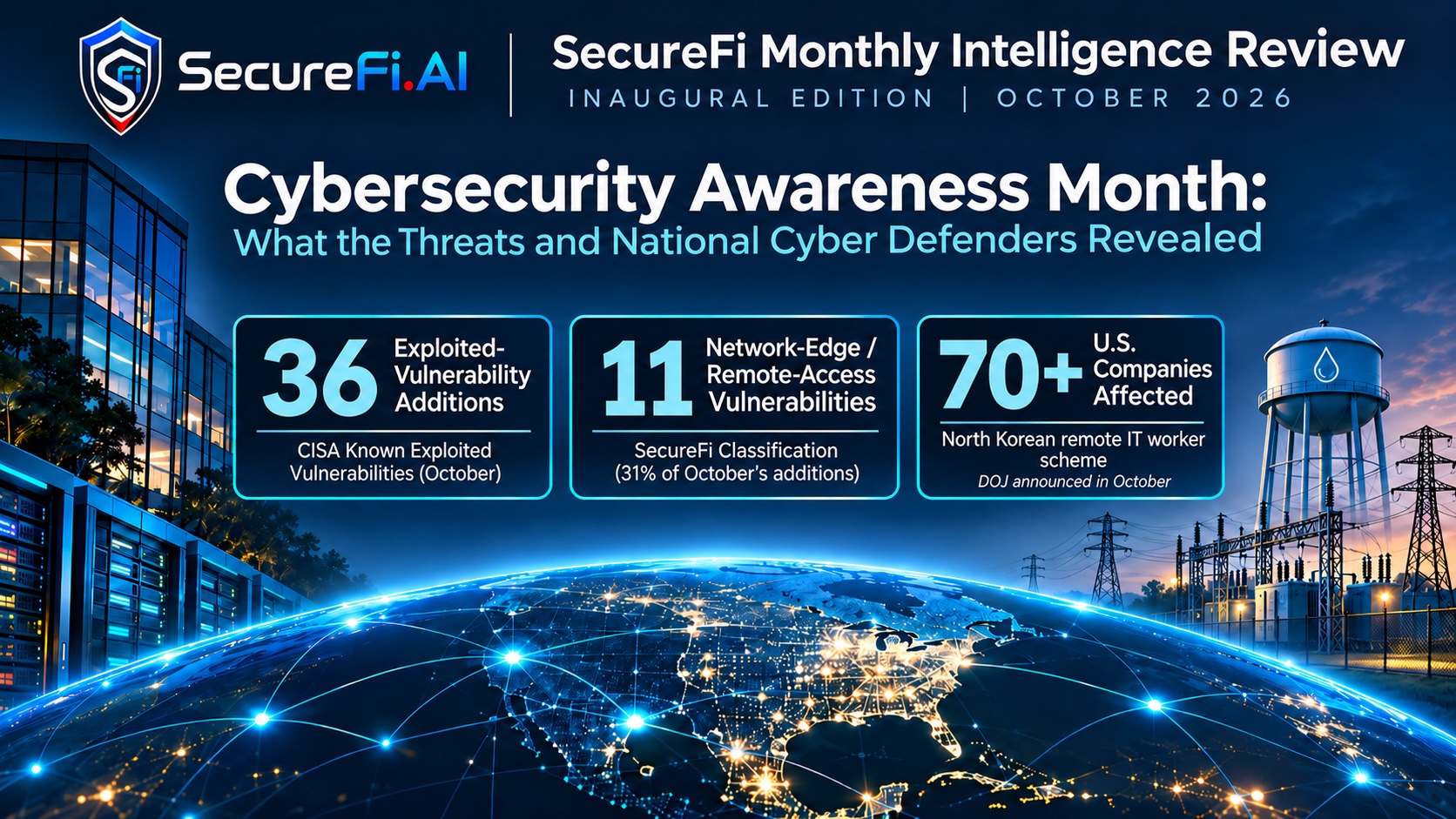
Meanwhile, the Cybersecurity and Infrastructure Security Agency (CISA) added 36 vulnerabilities to its Known Exploited Vulnerabilities catalog.
Across these developments, a recurring concern emerged: the security of trusted access.
Modern organizations depend on interconnected identities, devices, applications, suppliers, and infrastructure. Attackers seek opportunities to exploit those relationships.
October also reinforced the importance of detecting threats quickly, maintaining reliable situational awareness, and coordinating responses before disruption spreads.
1. October by the Numbers
The following figures represent specific government publications and reporting activity during October 1 to 31, 2026.
| Official measure | October |
|---|---|
| CISA Known Exploited Vulnerabilities catalog additions | 36 |
| FBI IC3 public service announcements | 7 |
| FBI and partner joint cybersecurity advisories | 4 |
| FBI Cyber Alerts page entries | 9 |
| FTC consumer alerts | 5 |
| Consumer Product Safety Commission recalls | 43 |
| California Attorney General breach notices | 53 |
These figures are not estimates of all cyberattacks, fraud incidents, vulnerabilities, or breaches occurring nationally. They represent publications within the specified reporting categories.
Joint advisories are counted once, regardless of the number of participating agencies.
Sources: CISA KEV Catalog | FBI Public Service Announcements | FBI Joint Advisories | FBI Cyber Alerts | FTC Consumer Alerts | CPSC Recalls | California Breach Notices
2. What National Cyber Defenders Emphasized
October's cybersecurity awareness activities addressed more than routine password and software updates.
Across NSA, CISA, the FBI, U.S. Cyber Command, and state cybersecurity organizations, three priorities stood out.
Verify identity and trusted access
U.S. Cyber Command's October awareness messaging highlighted multifactor authentication fatigue, spear phishing, fraudulent sponsored support advertisements, and AI-enabled voice impersonation.
In these scenarios, attackers attempt to exploit trusted identities or communication channels.
An employee may receive repeated login approval requests, a convincing message apparently from an executive, or an advertisement directing them to fraudulent technical support.
The underlying lesson is consistent: familiarity does not establish authorization.
NSA emphasized Zero Trust principles and stronger network-management security, including the use of SNMPv3.
Organizations should continuously evaluate identities, devices, permissions, and sensitive actions rather than assume a successful login establishes permanent trust.
Protect critical infrastructure and prepare for disruption
On October 8, NSA released guidance addressing Zero Trust in operational technology environments.
Operational technology includes industrial controls and equipment supporting utilities, manufacturing, transportation, and other essential services.
These environments may depend on aging equipment, specialized software, and systems that cannot easily be interrupted for maintenance.
The challenge is to strengthen security without compromising operational continuity.
CISA's October awareness messaging similarly emphasized resilience, securing network-edge devices, and preparing organizations to operate through disruptions.
One example at the state level was Texas Cyber Command, which held an Information Security Officer Summit on October 16 and continued statewide collaboration around cyber resilience.
Its Project Watershed 250 initiative, launched August 31, 2026, provides an example of cooperation among government, industry, and water utilities, including smaller providers with limited resources.
Prepare for AI and future cryptographic risks
NSA's October 1 post-quantum cryptography announcement emphasized preparing National Security Systems for future quantum-related cryptographic risks.
Texas Cyber Command's awareness programming addressed AI-generated deepfakes, quantum computing, and operational technology.
These are distinct challenges.
AI-enabled impersonation creates immediate risks to authentication and decision-making. Future quantum capabilities may threaten certain cryptographic algorithms currently used to secure communications and digital transactions.
Organizations should incorporate emerging-technology risks into long-term planning without confusing future threats with current attack methods.
References: U.S. Cyber Command LinkedIn awareness posts, October 2026 (MFA fatigue, AI voice impersonation, sponsored support ads, spear phishing) | NSA LinkedIn Cybersecurity Awareness Month post on Zero Trust and SNMPv3, October 2026 | NSA Router Hygiene Guidance recommending SNMPv3, July 13, 2026 (earlier guidance) | NSA Post-Quantum Cryptography Measures, October 1 | NSA Zero Trust for Operational Technology, October 8 | CISA Launches Cybersecurity Awareness Month, October 1 | CISA Cybersecurity Awareness Month resources | Texas Cyber Command LinkedIn post on the October 16 Information Security Officer Summit | Texas Cyber Command LinkedIn post on its October 20, 22 and 23 webinars | Texas Cyber Command Cybersecurity Awareness Month 2026 | Texas Cyber Command, Project Watershed 250, launched August 31
3. What Attackers Exploited
The awareness activities described defensive priorities. October's operational warnings illustrated the risks those priorities are intended to address.
Thirty-six vulnerabilities added to CISA's exploited catalog
CISA added 36 vulnerabilities to its Known Exploited Vulnerabilities catalog during October.
SecureFi's classification found that 11 involved network-edge or remote-access technologies, approximately 31% of the month's additions.
These included products associated with Ivanti, Fortinet, Cisco, Citrix, Palo Alto Networks, BeyondTrust, and Arista.
Such technologies often serve as gateways between external users and sensitive organizational systems.
A vulnerability affecting an access gateway, firewall, or remote-support product may therefore expose multiple connected services.
Several October additions concerned older vulnerabilities, demonstrating that a flaw's original disclosure date does not necessarily determine its current operational risk.
FortiBleed credential attacks
On October 6, the FBI and U.S. Secret Service issued a joint advisory describing FortiBleed operations targeting exposed Fortinet systems.
The campaign highlighted risks involving compromised credentials, authentication weaknesses, and remote-access infrastructure.
Organizations need to examine identity security alongside software configuration, patching, and monitoring.
SafePay ransomware
On October 20, the FBI, CISA, U.S. Secret Service, Germany's Rheinland-Pfalz state criminal police, and UK law enforcement partners issued a joint advisory concerning SafePay ransomware.
The guidance emphasized technical mitigations and measures organizations could take to reduce the likelihood and impact of ransomware attacks.
Protected backups, segmentation, access controls, incident-response preparation, and recovery testing remain important safeguards.
Critical PHP vulnerabilities
CISA and the FBI also warned about critical vulnerabilities affecting PHP, a programming language widely used by websites and applications.
These risks extend beyond software developed internally. Commercial applications and third-party products may include vulnerable components.
Organizations must understand not only the systems they operate, but also the software dependencies embedded within them.
References: CISA KEV Catalog | FBI and U.S. Secret Service FortiBleed Advisory, October 6 | #StopRansomware: SafePay Ransomware, October 20 | CISA PHP Warning, October 21 | FBI PHP Public Service Announcement, October 23
4. State-Sponsored Operations and Institutional Trust
October's federal announcements also showed how state-sponsored cyber activity, financial crime, and identity manipulation increasingly intersect.
North Korea and cryptocurrency theft
On October 31, the FBI attributed a cryptocurrency theft exceeding $6 billion from Binance to North Korea's TraderTraitor operation.
Binance's preliminary investigation described a possible attack path involving a compromised employee laptop and internal services. The complete technical sequence remained under investigation.
The case raises an important question: how can organizations prevent compromised identities or services from performing actions with consequences far beyond their intended authority?
SecureFi examines that question in its separate Intelligence Brief, The $6 Billion Breach: When Trusted Access Becomes the Attack Path.
North Korean remote IT worker schemes
On October 13, the Justice Department announced coordinated actions against North Korean remote IT worker operations affecting more than 70 U.S. companies.
The announcement described approximately 187 seized devices, criminal charges, arrests, and suspected laptop farms.
The Texas searches occurred September 21 to 25; the federal announcement followed in October.
These schemes involve individuals using stolen or fraudulent identities to obtain remote employment and access corporate systems.
They represent a different form of trusted-access risk from the Binance incident, although both demonstrate why identity and authorization require sustained scrutiny.
China-linked cyber operations
On October 8, the FBI, CISA, NSA, and international partners published guidance about Chinese government-linked actors using automated scanning and hands-on exploitation.
Separately, DOJ and FBI announced actions targeting Microscan and FishHub, tools associated with the Flax Typhoon operation and supporting malicious cyber activity.
The broader lesson is that organizations face adversaries using both automated techniques and targeted operations, sometimes supported by external infrastructure and commercial enablers.
References: FBI: North Korea Responsible for $6 Billion+ Binance Attack, October 31 | Binance Security Incident Update, October 30 | SecureFi Intelligence Brief: The $6 Billion Breach | DOJ Actions Against North Korean Remote IT Worker Schemes, October 13 | Joint Advisory AA26-281A on Chinese Government-linked Actors, October 8 | DOJ and FBI Seize Microscan and FishHub Tools, October 8
5. Breach Reporting: Visibility Can Lag Reality
California's October reporting list contained 53 breach notices.
However, the incidents behind those notices did not all occur during October.
| Reported incident year | October notices |
|---|---|
| 2026 | 38 |
| 2025 | 10 |
| Before 2025 | 2 |
| Unspecified | 3 |
Twelve of the 53 notices concerned incidents dating to 2025 or earlier.
That distinction matters for organizations assessing cyber trends.
An incident may occur on one date, be discovered later, and be disclosed to regulators or affected individuals much later still.
A monthly increase in breach notifications therefore does not necessarily indicate an equivalent increase in newly occurring breaches.
6. Three Institutional Priorities for November
1. Validate trusted access. Review privileged identities, remote workers, service accounts, third-party permissions, and approval controls governing high-impact actions. Consider what could happen if one authorized account or device were compromised.
2. Address active exploitation and test recovery. Compare CISA's exploited-vulnerability catalog with the organization's systems and dependencies. Prioritize exposed and business-critical services. Rehearse incident response, service continuity, and restoration procedures.
3. Turn threat intelligence into action. Maintain reliable sources, assign responsibility for evaluating relevant advisories, verify that important alerts reach the appropriate teams, and build relationships with external response partners before a crisis occurs.
November also brings Critical Infrastructure Security and Resilience Month, making operational preparedness especially relevant for utilities, public services, healthcare, transportation, and other essential sectors.
Holiday shopping and financial impersonation schemes will remain important consumer risks. Organizations should also monitor phishing and credential theft affecting employees, customers, and suppliers.
Closing Assessment
October demonstrated that cybersecurity awareness and operational defense are inseparable.
Government agencies emphasized identity protection, critical-infrastructure resilience, emerging-technology preparedness, and coordination.
At the same time, active exploitation, state-sponsored operations, ransomware, and delayed breach disclosures demonstrated why those priorities matter.
The institutional lesson is not that every organization faces the same threat.
It is that every organization depends on trust between employees, devices, software, suppliers, infrastructure, and external partners.
Those relationships must be understood, appropriately limited, monitored, and capable of surviving compromise.
Protect the systems. Verify the access. Prepare the response.
Methodology and Editorial Standards
This inaugural review covers selected government publications, cybersecurity advisories, enforcement announcements, and institutional developments associated with October 1 to 31, 2026.
Counts are drawn from specified official government publication catalogs and reporting systems. They do not represent the total number of national or global cybersecurity incidents.
Agency awareness content is presented separately from operational threat statistics. Joint advisories are counted once, regardless of participating agencies.
A vulnerability added to CISA's catalog in October may have been discovered earlier. A breach reported during October may have occurred months or years before publication.
SecureFi assessments are analytical interpretations of public information, not independently established investigative findings.
This inaugural edition establishes a reporting baseline. Future reviews will introduce month-over-month comparisons where consistent and reliable methods permit.
Sources and References
- Cybersecurity and Infrastructure Security AgencyKnown Exploited Vulnerabilities Catalog. Catalog version 2026.10.30.
- Cybersecurity and Infrastructure Security AgencyCISA Launches Cybersecurity Awareness Month: Securing the Next 250. October 1, 2026.
- Cybersecurity and Infrastructure Security AgencyCybersecurity Awareness Month. October 2026.
- National Security Agency
- National Security Agency
- National Security AgencyNSA and Partners Release Guidance on Improving Router Hygiene to Protect Against Russian State-Sponsored Targeting. July 13, 2026.Earlier technical guidance; cited for its SNMPv3 recommendation.
- National Security AgencyCybersecurity Awareness Month post on Zero Trust and SNMPv3 (LinkedIn). October 2026.Agency LinkedIn post, reposted by U.S. Cyber Command.
- U.S. Cyber CommandCybersecurity Awareness Month posts on MFA fatigue, AI voice impersonation, sponsored support ads and spear phishing (LinkedIn). October 2026.Agency LinkedIn posts.
- Texas Cyber Command
- Texas Cyber CommandPost on the 2026 Information Security Officer Summit, October 16 (LinkedIn). October 2026.Agency LinkedIn post.
- Texas Cyber CommandPost announcing Week 3 webinars on October 20, 22 and 23 (LinkedIn). October 2026.Agency LinkedIn post.
- Texas Cyber CommandProject Watershed 250. Launched August 31, 2026.
- FBI and U.S. Secret Service
- FBI, CISA, U.S. Secret Service and partners#StopRansomware: SafePay Ransomware (AA26-293A). October 20, 2026.
- Cybersecurity and Infrastructure Security AgencyCritical Vulnerabilities in PHP Require Immediate Patching. October 21, 2026.
- Federal Bureau of InvestigationPublic Service Announcement on PHP vulnerabilities. October 23, 2026.
- Federal Bureau of InvestigationNorth Korea Responsible for $6 Billion+ Binance Attack. October 31, 2026.
- BinanceSecurity Incident Update. October 30, 2026.
- U.S. Department of Justice
- FBI, CISA, NSA and international partners
- U.S. Department of Justice
- FBI Internet Crime Complaint CenterPublic Service Announcements. October 2026.
- FBI Internet Crime Complaint CenterCybersecurity Advisories. October 2026.
- Federal Bureau of InvestigationCyber Alerts. October 2026.
- Federal Trade CommissionConsumer Alerts. October 2026.
- U.S. Consumer Product Safety CommissionRecalls. October 2026.
- California Attorney GeneralData Security Breach Reports. October 2026.